
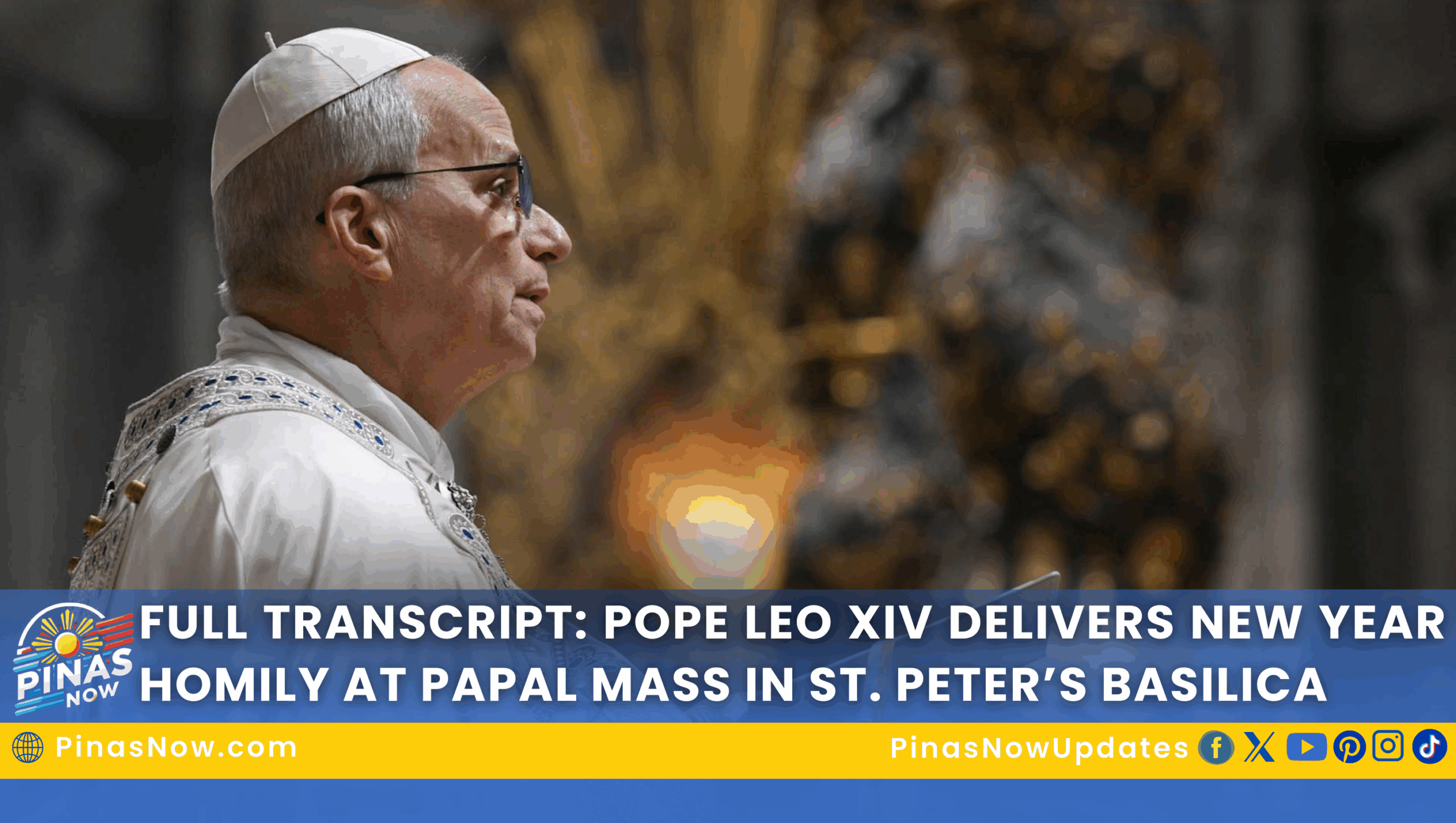
FULL TRANSCRIPT: Homily of Pope Leo XIV at the Solemnity of Mary, Mother of God (January 1, 2026)
 Pope Leo XIV delivered this homily during the Holy Mass on the Solemnity of Mary, Mother of God at Saint Peter’s Basilica on January 1, 2026, marking the beginning of the new civil year and the World Day of Peace. Reflecting on God’s ancient blessing from the Book of Numbers, the Holy Father invited the faithful to see the new year as a renewed journey of freedom, mercy, and hope. Centered on Mary’s divine motherhood, the homily highlights God’s “unarmed and disarming” love revealed in Jesus Christ and calls Christians to become witnesses of peace, forgiveness, and welcome in a world longing for reconciliation.
Dear brothers and sisters,
On this Solemnity of Mary, the Holy Mother of God, as we stand at the beginning of a new civil year, the Liturgy offers us the words of a beautiful blessing:
“May the Lord bless you and keep you. May the Lord let his face shine on you and be gracious to you. May the Lord uncover his face to you and bring you peace” (Num 6:24–26).
In the Book of Numbers, this blessing follows the instructions concerning the consecration of the Nazirites. It highlights the sacred and fruitful exchange that takes place between God and his people: human beings offer the Creator what they have received from him, and God, in return, turns toward them his benevolent gaze, just as he did at the dawn of creation (cf. Gen 1:31).
The people of Israel to whom this blessing was addressed were a people set free — men and women reborn after long years of slavery, through God’s saving intervention and the faithful response of his servant Moses. In Egypt, they had known a certain stability: food, shelter, and predictability. Yet all of this came at the cost of freedom. They lived under an oppressive tyranny that demanded ever more while giving ever less (cf. Ex 5:6–7).
In the desert, many of those comforts disappeared. Yet in exchange, they received freedom — an open road toward the future, guided by the gift of God’s law and the promise of a land where they could live without chains or fear. It was, in every sense, a rebirth.
At the dawn of this new year, the Liturgy reminds us that for each of us, every day can be the beginning of a new life. This is possible because of God’s generous love, his mercy, and the response of our freedom. The year before us can be seen as an open journey — one to be discovered with trust.
Through grace, we can walk this path with confidence: free and bearers of freedom, forgiven and capable of forgiveness, sustained by the closeness and goodness of the Lord who never abandons us.
This truth shines brightly as we celebrate the mystery of Mary’s divine motherhood. By her “yes,” Mary gave a human face to the source of all mercy and goodness — the face of Jesus. Through his eyes, first as a child and later as a young man and an adult, the Father’s love reaches us and transforms us.
As we move forward into the days that await us, let us ask the Lord to help us experience, at every moment, the warmth of his fatherly embrace and the light of his benevolent gaze. In doing so, we may better understand who we are and the marvelous destiny toward which we are journeying (cf. Gaudium et Spes, 41).
At the same time, let us glorify God through prayer, holiness of life, and by becoming mirrors of his goodness for one another.
Saint Augustine reminds us that in Mary, “the Creator of man became man… in order to free us, even though we were unworthy” (Sermon 191, 1.1). Here we encounter one of the most striking features of God’s face: the complete gratuity of his love.
As I emphasized in my Message for this World Day of Peace, God reveals himself to us as “unarmed and disarming,” as vulnerable and defenseless as a newborn child. He teaches us that the world is not saved by violence, judgment, or exclusion, but by patient efforts to understand, forgive, liberate, and welcome everyone, without fear or calculation.
This is the face of God that Mary welcomed and nurtured within her womb — a face that transformed her life completely. It is the face she contemplated daily as Jesus grew, and the face she followed faithfully along the path of his mission, all the way to the cross and the resurrection.
In Mary’s divine motherhood, we witness the meeting of two immense and “unarmed” realities: God, who sets aside every privilege to become flesh (cf. Phil 2:6–11), and a human being who freely and trustingly embraces his will. In love, Mary offers God her greatest gift — her freedom.
Saint John Paul II invited us to contemplate what the shepherds discovered in Bethlehem: “the disarming tenderness of the Child, the surprising poverty of his birth, and the humble simplicity of Mary and Joseph.” These realities transformed them into messengers of salvation.
Dear brothers and sisters, on this Solemnity, at the beginning of the new year, and as we approach the conclusion of the Jubilee of Hope, let us draw near to the Nativity scene with faith. Let us recognize it as the place of true, “unarmed and disarming” peace — a place of blessing, memory, and gratitude.
Then, like the humble witnesses of Bethlehem, let us set out once more, “glorifying and praising God” (Lk 2:20) for all that we have seen and heard.
May this be our commitment and our resolve for the months ahead, and for the whole of our Christian lives.


